Jiyoung and Daehyun decide to have a child
Kim Ji-young, Born 1982Kim Jiyoung and Jung Daehyun’s decision to have a child is both a step in their marriage and a negotiation over who will bear the consequences. What Daehyun first proposes as a way to quiet his parents’ questions becomes, for Kim Jiyoung, a decision about her body, career, and future. Their conversations bring the unequal stakes into view: the couple discusses parenthood together, but the solutions available to them are shaped by work, family resources, and the customary expectation that a mother will provide care.
Family Pressure and the Question of Timing
After the wedding, relatives on both sides wait for news of a pregnancy. Auspicious dreams prompt calls to Kim Jiyoung, and after several months without news, relatives begin to wonder whether she has a health problem. At a birthday gathering for Daehyun’s father in Busan, family elders question why the couple has not conceived and speculate about Kim Jiyoung’s age, build, cold hands, and even a blemish. Though she and Daehyun have not planned to have children yet, their relatives treat her fertility as a matter for family investigation. Kim Jiyoung holds back her objections and declines an aunt’s suggestion that Daehyun’s mother obtain fertility medicine for her.
The drive back to Seoul becomes a conflict between the couple. Kim Jiyoung is hurt that Daehyun stayed silent while his relatives scrutinized her; he says he wanted to avoid antagonizing them and making the matter larger. He regards her reaction as excessive, while she feels that he is dismissing the injury rather than understanding it. His eventual suggestion that they have a child so his parents will stop nagging therefore arrives after a failure of support. To Daehyun, having a child seems like a practical way to end the lectures, especially since he assumes they will eventually become parents. Kim Jiyoung hears a decision with consequences too large to treat as a convenient answer to family pressure.
Unequal Stakes in the Couple’s Discussion
Kim Jiyoung has little close experience of pregnancy or newborn care: her sister, who married a year earlier, has no child, and most of her friends who married later are also childless. She cannot know in advance how pregnancy will change her body. More pressing, she doubts whether she can sustain her career while raising a child. Both spouses work late and on weekends, while neither set of parents is in a position to provide regular care. Daycare or babysitting does not resolve the question in her mind; she worries that they might have a child for whom they would not have enough time, and feels guilty for already considering another person’s care before the child exists.
Daehyun listens as Kim Jiyoung explains her anxiety and offers to change diapers, feed the baby, and wash its clothes. He urges her to consider what parenthood would bring, not only what it would cost, and says he would support the family financially if childcare made it necessary for her to leave her job. Kim Jiyoung then asks what he himself expects to give up. She names the youth, health, job, colleagues, social ties, career plans, and future she feels she is placing at risk. Daehyun anticipates seeing friends less, coming home earlier, feeling uneasy at business dinners or late work, and helping with chores after work; he also describes financial support as a major responsibility. Kim Jiyoung tries not to respond emotionally, but finds his expected sacrifices slight beside the disruption she faces. His willingness to help matters, yet it does not make the possible losses equal, nor does his offer of financial support replace work she values for its own sake.
From Agreement to a Childcare Plan
The narrative places a small, unusual episode during the couple’s deliberation. On a weekend walk in a nearby arboretum, they find a large radish partly buried in a meadow. Daehyun compares the discovery to a children’s story about a radish and calls it a strange dream. The episode does not settle their disagreement, but its placement beside their discussion of a child gives the story a quiet, storybook counterpoint to the practical questions they must answer.
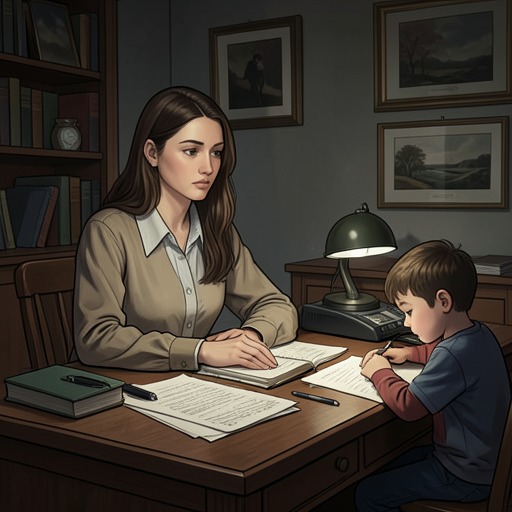
As the due date approaches, Kim Jiyoung weighs taking maternity leave against leaving work altogether. She and Daehyun write three possibilities on a large sheet of paper: her returning immediately, returning after a year of leave, or not returning. For each they consider who would care for the baby, the cost, and other advantages and disadvantages. If both remain employed, the practical choices are sending the child to Daehyun’s parents in Busan or hiring a live-in nanny. His parents offer to raise the child, but they are elderly and his mother has recently undergone back surgery. A live-in caregiver would share the couple’s household and daily routines, and the couple worries about finding someone who suits the family as well as caring for a child. The expense and uncertainty about how long such an arrangement would last add to their concerns.
They conclude that one parent must stay home, and that parent is Kim Jiyoung. Daehyun’s work is more secure and better paid; beyond that economic difference, the familiar arrangement in which husbands work and wives raise children reinforces the same outcome. Kim Jiyoung had anticipated the decision, but anticipation does not protect her from feeling depressed. Daehyun suggests occasional babysitting and daycare later, so she can study and look for other work, framing the change as a possible new chapter. His reassurance leaves intact the immediate fact that she, rather than he, will interrupt her career.
Consequences and the Meaning of the Decision
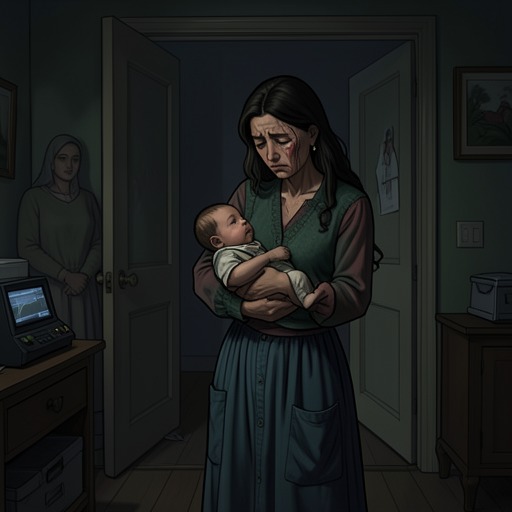
The eventual arrival of Jung Jiwon makes the earlier discussion concrete. A little past her first birthday, Jiwon begins daycare and adjusts well. Her schedule runs from a 9:30 a.m. drop-off through a snack, playtime, and lunch, with Kim Jiyoung collecting her before 1 p.m. The daycare interval gives Kim Jiyoung approximately three hours, but most of that time goes to laundry, dishes, tidying, and preparing food; she has little opportunity simply to sit with coffee. The change gives her a stretch of time without the baby beside her, not freedom from domestic work.
The account places this experience against statistics on mothers’ daily time: a stay-at-home mother with a child under two has four hours and ten minutes to herself, while a mother who sends a baby to daycare has four hours and twenty-five minutes, a difference of only fifteen minutes. In Kim Jiyoung’s case, daycare makes it easier to concentrate on household tasks and, when the teacher says Jiwon may eventually nap there and stay later, opens the possibility of starting something new. The path from the couple’s decision to parenthood thus remains unsettled: Kim Jiyoung gains a potential opening, but only after a plan assigns her the primary interruption and the ongoing care. The decision is presented not as a single private choice insulated from society, but as a family negotiation whose terms have already been narrowed by relatives’ expectations, workplace demands, income differences, and gendered custom.